I was surprised this week by the new International Olympic Committee guidelines on transgender women in sport. They say there should be no presumption that transgender women (humans who were born male but identify as female) have a physical advantage over females. This is an odd thing to say. All my life I’ve observed male physical advantage; it is what I was taught in high school biology and later observed at university in anatomy classes. It made me question whether everything I knew to be true about this was suddenly not true.
The literature says otherwise. A paper published in 2020 in Sports Medicine says,
These data overwhelmingly confirm that testosterone-driven puberty, as the driving force of development of male secondary sex characteristics, underpins sporting advantages that are so large no female could reasonably hope to succeed without sex segregation in most sporting competitions.
The authors explain the reasons. Males have larger and denser muscle mass, stiffer connective tissues, less fat, they are taller and larger, have superior cardiovascular and respiratory function with larger blood and heart volumes, higher hemoglobin concentration, and a lower oxygen cost of respiration.
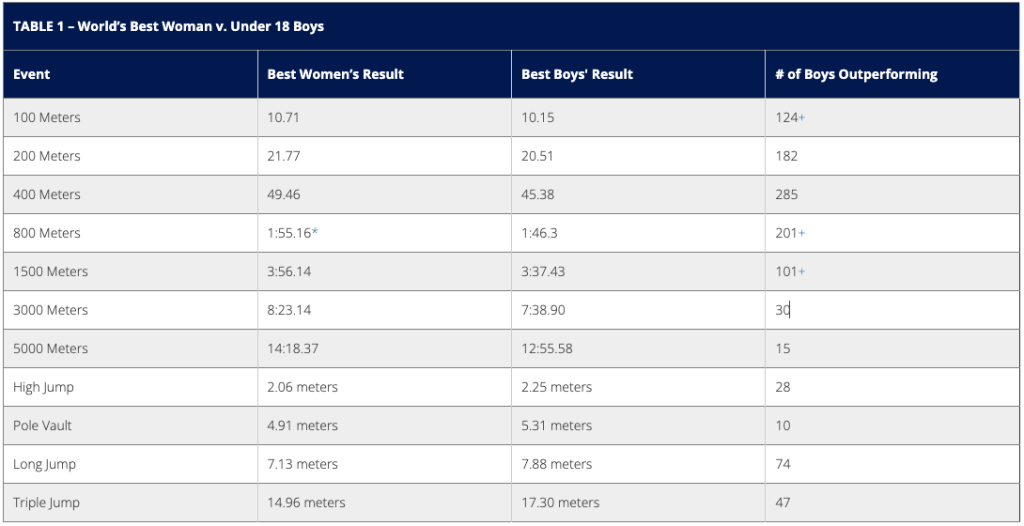
There’s a 10-12% performance gap between elite males and elite females in sport. In the year 2017, the female Olympic champion for the 400m, Allyson Felix, had her personal best of 49.26 beaten 15,000 times by boys and men. That’s just in one year. Boys under 18 outperform the best women in all of the following events.
The difference is even greater when we compare men with women. See table 2 on Comparing Athletic Performances.
World Rugby is the only sporting federation to ban transgender women from the women’s category. Their reasons are very similar to the 2020 study I reference above.
Males have:
- Larger and denser lean muscle mass
- Greater force-producing capacity of skeletal muscle
- Stiffer connective tissue
- Reduced fat mass and different distribution of body fat and lean muscle mass
- Longer, larger and denser skeletal structure
- Changes to cardiovascular and respiratory function that include higher haemoglobin concentration, greater cross-sectional area of the trachea and lower oxygen cost of respiration
I haven’t read all the papers they reference but they list them if you want to look them up.
I don’t play sport so none of this affects me personally but I have a strong sense of fairness and this is not fair. Why have a women’s sports category at all if biological males can compete in it? I did compete in athletics in high school and came 8th in my state for high jump one year. I would never have achieved that had I been competing against males. Maybe that doesn’t matter to me but I’m sure it matters to elite female athletes most of whom are silent. A paper published in June this year found that the majority of athletes felt they couldn’t discuss this issue at all without being accused of transphobia.
I became interested in this topic during the Olympics this year when I saw the New Zealand weightlifter, Laurel Hubbard, compete in the women’s category despite being born male and going through male puberty. Although she did not win she’s in her 40s while the average age of Olympic weightlifters is 26 for men and 25 for women. In 2019 Hubbard won two gold medals in the Pacific Games in Samoa, beating two Samoan women. The Samoan women should have taken gold and silver. It’s a bit like me competing in a children’s running race and coming first. There is no integrity in that which is why we have juniors and seniors events. It creates a level playing field.
Transgender women can still compete in sport but in the male category. The male category is an open category that anyone can enter. There are also non-competitive non-elite sports that anyone can participate in. What is happening currently is wrong and unfair.
The Real Science of Sport Podcast has a good episode on this topic.
I’ll finish with a quote from Professor Ross Tucker who describes the IOC guidelines in the podcast as:
a politically influenced, cowardly unscientific document.
Prof Ross Tucker The Real Science of Sport podcast S3 E27


 rachel.blog
Leave a reply to Rachel M Cancel reply