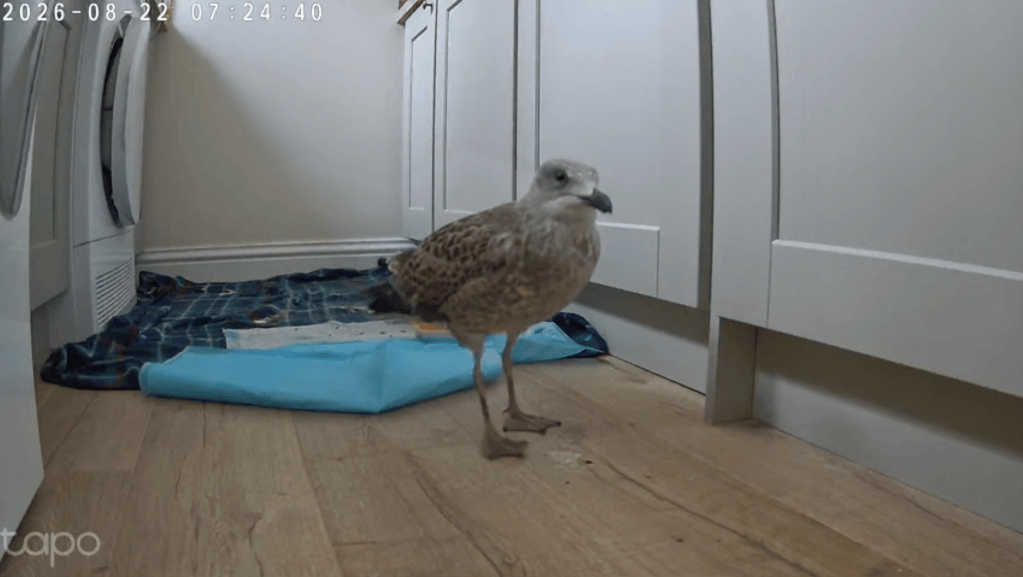
Last month I picked up a juvenile gull at St Nicholas Kirk in Aberdeen who was unable to fly and having difficulty standing and walking.
I took him home and cared for him from the Tuesday afternoon 18th August until Saturday morning 22nd August. During that time he improved. When I first found him he spent much of his time sitting on his hocks and looked sullen and unwell. As the week went on, he began standing and walking much more and looked brighter and more alert. I named him Bertie.
On the Friday night I let him loose in the laundry – he had previously been in a dog crate – because I wanted to see if he could fly and he could! I got this video of him on the Saturday morning.
All week I was wondering what to do with him. I was reluctant to hand him over to a rescue organisation because euthanasia has been the outcome for every gull I have previously “rescued”.
But Bertie continued to improve.
He was eating and drinking, and I could see no visible signs of trauma. His droppings appeared normal in colour and consistency. He was still wobbly on his legs but much stronger than he had been on the Tuesday.
On Thursday I paid for an online veterinary consultation and supplied the vet with the many videos I had taken of Bertie. I wanted reassurance that there wasn’t something catastrophic going on that I couldn’t see. Based on the videos, the vet thought Bertie had a good chance of recovery. He said there was no obvious deformity, fractures or swelling, and he was standing, eating, drinking and pooping (some of the videos showed him pooping).
By Friday I had to make a decision as he needed more space in which to practise flying and regain his strength. I contacted both New Arc and the SSPCA. My conversation with the SSPCA left me with the impression that Bertie would receive further professional care at its National Wildlife Rescue Centre at Fishcross. On that understanding, I agreed to hand him over to an officer on Saturday though I made it clear that I was happy to continue caring for him until the following week if necessary.
An SSPCA officer came over on Saturday morning about 30 minutes after I got this video of Bertie preening himself.
When the officer examined him she looked as his feet and said they appeared to have bumblefoot. She also mentioned the possibility of him having parasites. I found this strangely reassuring at the time as both sounded like things that could be treated. I asked whether she would be taking him to Fishcross. She said no, explaining that they have others for transport of that distance. I also asked which vets they use but she gave a generic answer rather than the name of a particular vet. I also asked to be kept informed of his progress and was told she wouldn’t have time for that so I said I would email next week.
At no point during that conversation was I told Bertie was considered beyond rehabilitation or that the officer intended to euthanise him. Had I known that was going to happen, I would never have handed him over.
When I first picked up Bertie, I told him I wouldn’t hurt him. I told him he would be ok and that he could trust me. Those words torment me now. I handed him over because I genuinely believed I was giving him a better chance of receiving the specialist care I couldn’t provide at home.
Bertie was euthanised by the SSPCA that same day.
Since then I have repeatedly tried to understand what led to that decision.
When I first asked why Bertie had been euthanised, I was told that he was “emaciated”. I asked for the physical examination findings and clinical reasoning behind the decision.
The second response described him as “significantly emaciated and actively suffering”.
I again asked for the clinical findings and supplied the videos showing Bertie flying and actively preening.
Avian influenza was raised for the first time in the third response I received. Why was it not mentioned as the reason for euthanasia in the first instance?
I asked again asked for the contemporaneous record of Bertie’s assessment including his weight, clinical findings, behavioural observations and anything else recorded by the officer who actually examined him.
In their fourth reply, avian influenza became central to the explanation. They also confirmed that no veterinary advice had been sought in Bertie’s case. The decision to euthanise him was made by the animal rescue officer who collected him.
I still don’t know where he was euthanised. I have wondered ever since whether she did it outside our house immediately after picking him up.
Eventually I escalated the matter to stage 2 of the SSPCA’s complaints procedure. My central question was very simple: what was actually observed and recorded during Bertie’s examination that led to the conclusion that he was so severely ill that immediate euthanasia, without veterinary assessment or an attempt at rehabilitation, was the appropriate course? What was his weight, temperature, physical and behavioural signs and what specific findings led to an assessment of avian influenza?
The Scottish Government’s published guidance on highland pathogenic avian influenza (HPAI) (Page 37) does not list emaciation as a clinical sign. The observable signs it does list include lethargy, recumbency, loss of balance, tremors, dragging of the legs, abnormal head or neck position, loss of appetite, respiratory distress and discoloured or watery droppings. It adds that some birds my show minimal clinical signs and that the presence of HPAI can only be confirmed with laboratory tests.
I received the final response to my stage 2 complaint yesterday.
The SSPCA’s position is that Bertie was severely emaciated and that this is a sign of avian influenza in gulls, that their officers are trained to do clinical triage in the field and that bringing a bird with avian influenza to the rescue facility could endanger other birds there.
I understand the seriousness of concerns related to avian influenza but I still haven’t received an answer to my question: what were the objective findings in Bertie’s case that justified immediate euthanasia?
The SSPCA has declined to provide me with its internal admission notes or paperwork relating to Bertie. It has told me that this is their full and final response and I can take the matter no further. They ended their response by saying they appreciated my continued support as a monthly donor and volunteer. I have now cancelled my monthly donation and ended my involvement as a volunteer.
So I still do not know Bertie’s weight. I have not been given a body-condition assessment or the other contemporaneous clinical and behavioural findings I repeatedly requested. I still don’t know whether suspected avian influenza was actually recorded by the officer at the time.
And I still don’t understand how the bird in the videos I took that morning – standing, walking, flying and preening – was judged to have so little prospect of recovery that euthanasia without veterinary advice was the appropriate outcome.
I’m writing this partly as a therapeutic exercise for me – it still pains me when I think of him – but also because I wish I had asked more questions before handing him over. Do not hand a wild animal over to the SSPCA without getting answers to explicit questions first: where will it be taken? Will it be assessed by a vet? Under what circumstances will you euthanise immediately?
I have lost all trust in the SSPCA and will not entrust another animal to their care.
 rachel.blog
Leave a comment