
Both kids are in the thick of exams right now. Elizabeth is doing iGSCE and Daniel the International Baccalaureate (IB). Elizabeth has 16 exams in total which seems like an enormous number but she’s managing it all very well so far. Daniel has 14 and is through the worst of it as he completed the last English exam he’ll ever have to do last Friday so a huge weight has lifted off his shoulders.
The IB qualification is very demanding and unlike A-levels and Scottish Advanced Highers, students must take a broad range of subjects including English which has been very challenging for Daniel. He’s ambitious and naturally gifted at STEM subjects for which he gets high grades. He wants to get a high grade for English but there’s no clear pathway for achieving that. With maths it’s quite different – learn and understand the theory, study hard, and it’s easy to know whether you have the answer right. Even with French – which he does pretty well in – it’s clear what you need to do to get a good grade. But with English, the pathway to success is blurry. Many nights over the last year he’s been up late fretting about English and complaining that he just can’t analyse a piece of text because he has no opinion of it. How do you get better at English aside from reading and writing which is not a sure-fire way to success? It does seem like one of those subjects you’re either good at or not good at it. Thankfully it’s all over for him now and he’s feeling reasonably happy with how it went.
Elizabeth is also gifted in STEM subjects and not a fan of writing essays for English. She’s still got three English exams to go. In the middle of all this she’s been keeping up with her extra-curricular activities. Yesterday was a highland dance competition where she came a respectable 4th overall and more importantly got another intermediate stamp. She only needs one more stamp now and she can move to premier. Even more exciting is next Friday she’s getting to perform on stage at the Music Hall with renowned Celtic band Capercaillie as the traditional Scottish music group she plays with has been invited to perform two songs on stage with them. What an honour! We’ll definitely be going to see them. Here she is holding her trophy from yesterday.

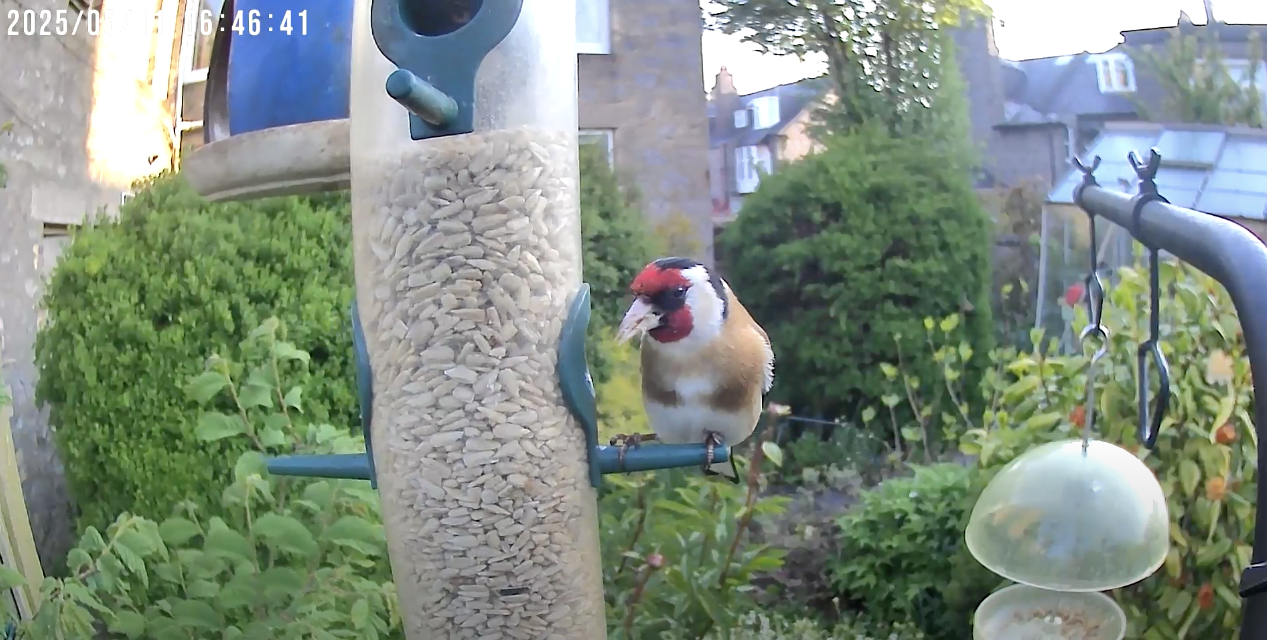
I’ve been getting lots of lovely footage of birds at the feeder. We still get the pigeons but there seems to be enough opportunity for the little birds to have a go like this bluetit with a bit of cobweb stuck to his tail feathers and a robin.
This video has a starling, house sparrow and finch visiting the feeders. House sparrows and starlings are both on the red list as a conservation concern so it’s nice to see them in the garden and know that I can help them a little bit. What is the meaning of life if not to help others as much as possible?
I enjoyed this podcast with Rutger Bregman, Peter Singer, and Kasia De Lazari Radek on the pursuit of moral ambition. Bregman is a Dutch historian and he talked about the idea of moral envy which he felt after reading about the anti-slavery movement. There were abolitionists throughout the world but only the British movement was effective. The Dutch abolitionists were mostly academics writing about why it was wrong but not actually doing anything effective. The American abolitionists were not very practical and alienated people. The British however were very pragmatic and achieved great success with their campaign to boycott sugar produced by slavery in the West Indies.
What is the great fight today? It’s factory farming of course. Here’s what Bregman says about it:
And then, the dearest cause to me is the fight against factory farming. It’s a question that I’ve always found fascinating: How would future historians look back on us? For us, it’s easy to look back on the Romans and say, “Oh, these were such bad people because they threw people before hungry lions.” But then the Romans would say, no, we’re civilised. We don’t sacrifice children anymore; the barbarians do. So, throughout history, all these big civilisations have seen themselves as the most civilised, and we seem to be doing that today as well.
It would be a nice coincidence if we were the first civilisation to figure it all out. However, that’s a very intellectually lazy position because there are straightforward ways of figuring out some things we’re doing wrong today.
And for me, the way we treat animals is the most obvious example. Philosophers and great thinkers have warned us about this for a long time. Utilitarianism has a great track record here. You both know the famous footnote from Jeremy Bentham in the late 18th century, where he said, it’s not about whether animals can talk or reason. That doesn’t matter. It’s about whether they can suffer. And we’ve got a Mount Everest of evidence now that shows, yes, they can suffer terribly.
And most people, what’s interesting — you must have experienced this as well – is that sometimes I get these invites from journalists who say, “Hey Rutger, do you want to debate factory farming, the ethics of it, on television?” And I say, “yeah, sure. But you won’t find anyone willing to defend the other side.” And usually that happens — they come back a couple of days later and say, “We can’t do the debate because no one wants to come out in defence of this moral atrocity.”
What can we learn from the abolitionists to bring an end to the great moral tragedy of our day? There is a lot of overlap between the anti-slavery movement which sought to end the exploitation of human animals and the animal rights movement which seeks to end the exploitation of non-human animals. One of the heroes of the anti-slavery movement, William Wilberforce, was also a key figure in the formation of the RSPCA. Elizabeth Heyrick, another campaigner against slavery also once saved a bull from a bull-baiting contest by purchasing it and hiding it in a nearby cottage much to the displeasure of an angry mob.
More animals are now abused and tortured on factory farms than ever before and it continues to grow. In China there are 26-storey skyscrapers that raise 1.2 millions pigs for slaughter each year. When I first became vegan 20 years ago the world raised and slaughtered around 50 billion chickens each year. That number is now 75 billion. Things have got worse. That’s not to forget we have had some wins. For instance, sow farrowing crates have been banned in the UK since 1999 and also in many European countries. People are more aware of the suffering of farm animals and slaughter houses have CCTV footage. But we still see regular stories of animals being abused on factory farms and more people eat animals on the planet than ever before.
If we were to learn from the diplomacy and pragmatism of the British anti-slavery movement how could we apply it to factory farming? Could it be to ask people not to give up the meat that they love completely but instead to eat it less regularly, say once a week, and on those occasions to eat game or meat that comes from small family farms with the highest of animal welfare credentials? And could we then boycott the big factory farms and put them out of business? It’s not just the animals themselves who benefit but we would too because those big factory farms are incubators of viruses, they are intensely polluting and they are accelerating our frightening march towards antibiotic resistance.


 rachel.blog
Leave a reply to Rachel M Cancel reply