The Aberdeen City Council has really been getting a hammering from residents in Aberdeen about the installation of a segregated bike path at the beach. I can see what an uphill battle it is for cycling here. Some of the comments I’ve seen are extraordinary. One woman wrote:
okay well I’ll carry on as normal then and block the cycle path with my car door and the cyclists can go up on the pavement making the cycle path redundant
This just confirms the stereotype in the cartoon of the selfish motorist.
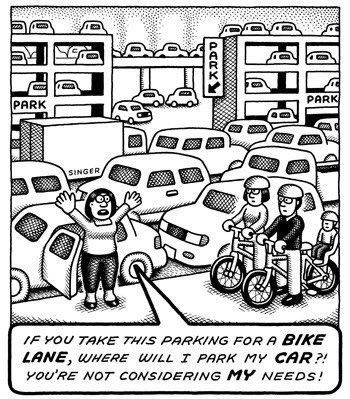
And there’s all the usual comments about cyclists not paying road tax and therefore undeserving of infrastructure. I’ve started telling people they should ask for a refund if they’re paying road tax because it was abolished in 1937. It’s exhausting seeing that myth repeated over and over.
And then other people tell me cyclists are a danger to themselves, as though we deserve to be hit and killed by their vehicle. And another comment, “I don’t want a safe place in town for my kids to cycle.” Because of course if we don’t want something for ourselves then no one else should be allowed it either, right? It’s like saying I have no use for wheelchair ramps at supermarkets, libraries, and health centres, therefore I don’t support the construction of any of these things. That would be a very selfish and unreasonable position to take. I fully 100% support accessibility access in all spaces.
One of my jobs at work is to bring our product up to AA web accessibility standards. Something I’ve learnt about designing for accessibility is that when you make something good for an extreme user like someone in a wheelchair, you inadvertantly benefit other groups as well. Ramps benefit not just wheelchair users but mums and dads with prams, elderly people who may have difficulty navigating steps, and small children. It’s called universal design.
Cycle paths are a bit like this because you don’t have to be a cyclist yourself to benefit from cycling infrastructure. Cycling infrastructure can be used by people on mobility scooters, skateboards, rollerblades, scooters, even wheelchairs. Indirectly cycling infrastructure benefits everyone through reduced greenhouse gas emissions, cleaner air, lower health care costs, lower road maintenance costs, and less traffic.
It is distressing to see some people put their own convenience before the safety of sons, daughters, mother, fathers, grandparents, aunts and uncles on bikes but I take comfort from movements of the past like women’s rights and the anti-slavery movements. I have no doubt that the past Rachel would have been up to her neck in those movements too and probably would have faced similar hostility albeit not in an online environment. We can do this. It will just take time and perseverance.


 rachel.blog
Leave a reply to Sustain blog Cancel reply